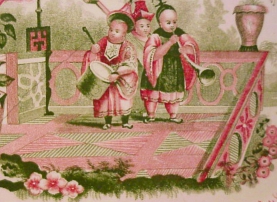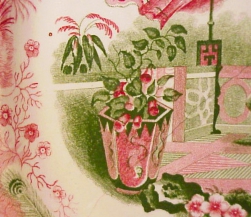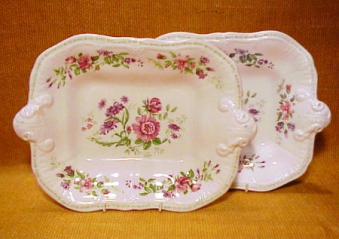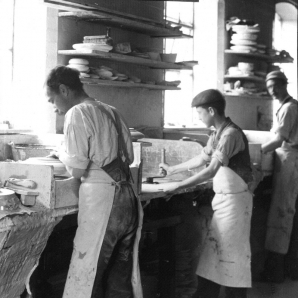



It was around 1870. The moving force in the English design scene was the burgeoning interest--soon to become a mania--for objects imported from or designed in the style of Japan. Minton introduces a new pattern that differs strikingly from the transferware that preceeded it and would stand in contrast with most of the Japanese-inspired patterns that would follow. A stark empty ground, no border, was littered with curious prints of plants, birds, fish and animals. The brightly enameled motifs seemed to be placed haphazardly and, moreover, differed from piece to piece.
As original as the tableware may have seemed, however, it was derived, really quite shamelessly, from a service that had appeared on the French market a short time before. Just as intriguing is the influence the pattern had on artistic tablewares in the decades to follow. This month's "Featured Item" entry will focus on one dinner plate to explore the phenomenon of Minton's "Naturalist" pattern.
http://www.seekersantiques.com/item?itemid=TCL21&catid=4&start=5
Dimensions; Diameter 10 1/4 in.
Dates: Date Mark for 1870
Price: $450.00
Origins: Japan and France
Shift to 1814 Japan. The great painter and printmaker Hokusai, in the fifty-fifth year of his epic life, began a series of publications that would appear periodically for the rest of his life and continue posthumously after 1849. Each was a small volume containing numerous printed images from his sketches, economical and closely observed micro views of the world around him--people, flora, all manner of fauna, even landscape elements. The volumes were known as Hokusai Manga (often translated as "random sketches"). Some sketches occupied an entire sheet, but best known are the pages crammed with numerous small drawings against a blank background, each existing as an independent and complete image. The effect to modern eyes is similar to a sheet of "clip art," and given the use to which the Manga was put in Europe, the analogy is an apt one.
Forward to 1856 Paris. The French artistic community was especially receptive to the influx of Japanese goods that followed on the heels of Admiral Perry's expedition to Japan. A frequently cited story has it that the painter and innovative etcher Felix Bracquemond discovered a volume of the Manga in the Paris shop of his printer. (Supposedly it had arrived in France with other prints as fill in an importer's crate.) Under its spell, Bracquemond became a leading exponent of the Japanese aesthetic, even joining a secret society of artists and collectors based on a shared study of Japanese prints.
An 1866 commission from the Parisian retailer Eugene Rousseau gave Bracquemond the opportunity to apply his connoisseurship to the creation of an earthenware dinner service utilizing Japanese motifs. The result is generally acknowledged as the first example of Japanism in French decorative arts. In preparation for the printed decoration of the set, Bracquemond prepared engraved sheets of images derived from the Manga and other sources. These were to be cut apart and positioned on the wares at the discretion of the decorator, the unadorned surface of the plate or vessel providing a neutral ground. The only other ornamentation was a molded shell edge, recalling eighteenth century earthenwares, highlighted by a strong cobalt blue wash. The random principle of Bracquemond's design is captured in the title of a later pattern he designated "Fleurs et Oiseaux Jetes" which translates as "Scattered Flowers and Birds ."
The Minton "Naturalist" Pattern
In 1869 Minton engaged William S. Coleman to develop their own version of the Rousseau service which was ultimately called the "Naturalist" pattern. Coleman, an artist and illustrator, worked on a freelance basis, later joining the firm as head of its art pottery studio in Kensington. His design closely follows Bracquemond's, only creating an even starker effect by eliminating the border treatment all together. The absence of a border is only one of the conventions of transferware broken by Coleman's design. The British consumer was unused to asymmetry or to the idea of a random scattered decoration that differed from piece to piece.
In production the placement of elements was not as truly random as Coleman might have envisioned. As with the Rouseau service the motifs are arrayed roughly in a circular manner around the plate, leaving the center vacant. Most plates display a formula of a large image balanced by two or three smaller ones. Without much effort, moreover, one can find practically identical plates.
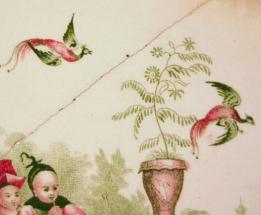
At times one senses that the decorators may have rebelled against the notion of unrelated floating motifs, as suggested by our featured plate. Here the prints are arranged to create a sort of river scene--kingfisher above, carp below, butterfly and reeds in between. If one looks closely, one can even discern faint blue lines inserted by the enameler to distinguish between water and sky. This bit of cheating does not seem to occur in the Rousseau pieces.
Influence
While the principle of random decoration may not have been fully realized in Minton's product, the scattered image composition of the "Naturalist" pattern had a strong observable impact on many of the aesthetic style patterns that followed. To single out just two examples (both available in Seeker's current inventory) Minton's later "Tom Tit" pattern and George Jones's evocatively named "Almonds" show the same informal balance of related, but separate, images. The plates in these patterns are identical except for possible variations in enamel colors.
A more subtle influence was the introduction into British ceramics of a Japanese sense of observed nature via Bracquemond and Coleman. Let's consider the depiction of our kingfisher. Traditionally birds in European ceramic decoration had been depicted in quite conventional ways, sometimes so formulaic that they become identifiable elements for a potter (like Derby's "Fancy Birds" or Worcester's "Disheveled Birds"). Compare the kingfisher to a bird from an 1840's transfer pattern. Far from the traditional perched bird profile, Coleman's bird is seen from above, foreshortened in perspective, almost a blur of color in flight. An unexpected view, but one undeniably closer to the nature of birds.
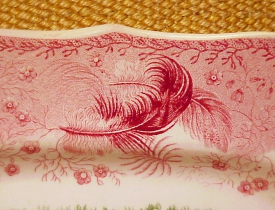
Hokusai was known for novel, sometimes even grotesque, views of nature, but views entirely rooted in observation ,not convention. The introduction to one Manga volume quotes his dictum, "There can be no teacher in painting. All you need do is copy reality." When one notes that Coleman's vocations included that of a natural scientist (he produced illustrated volumes on British butterflies and woodland life), one can see that he was the right man to transmit this aesthetic. His scientific point of view is revealed in another "Naturalist" plate decorated with specimen feathers. The pattern name itself takes on additional meaning.
http://www.seekersantiques.com/item?itemid=TCL17&catid=4&start=5
Striking images of natural creatures abound on the British aesthetic influenced tablewares that were to follow. We will let one example suffice--a later design by Coleman for Minton, the "Aquarium" pattern. Here Coleman turns his attention to underwater life, but despite the name, this is not the tame realm of the parlor fish bowl. Instead Coleman includes curious and sometimes fierce specimens; the carp on our dessert plate is a relatively friendly example. In contrast to "Naturalist" wares, here a single vignette has expanded to dominate the plate; Minton uses additional prints of aquatic plants, often overlapping, to reinforce the watery impression.
http://www.seekersantiques.com/item?itemid=TCL20&catid=4&start=5
When we think of the ceramics of the Japanese mania, we rightly think of those designs that lift elements directly from Japanese artifacts: tightly patterned grounds, flashing diagonals, Asian symbols and motifs, and so on. While they lack these overt signs, the Rousseau Service and the "Naturalist" pattern deserve their place in the advance guard of the movement. What they convey is a Japanesque sensibility, a way of looking at the world from an angle that differs from the traditional European view. The quality that seemed fresh, whimsical, a little confounding, but ever intriguing to the 1870's consumer and would-be aesthete exerts the same force on us today.
Acknowledgements and Sources
As is often the case with this website, we owe thanks to our good friend Stephen McMaster for his patient guidance to us on images and sources. Thanks also to our friend, ceramic scholar Rob Hunter, for sharing images of the Rousseau Service plates from his collection.
As always, the most accessible and best source for information on Minton remains Paul Atterbury and Maureen Batkin, The Dictionary of Minton, Antique Collector's Club 1990.
A little known element of James A. Michener's works is a seriously written and beautifully produced 1958 volume, The Hokusai Sketch-Books: Selections from the Manga. The images and Hokusai quotation come from this source (pp. 95, 91, 25). Thanks again, Stephen, for the loaner.
Information on Bracquemond and the Japan craze in France comes from the catalog of a wonderful 1975 exhibition shared by Rutgers, the Walters and the Cleveland Museum--Japonisme: Japanese Influence on French Art 1854-1910 (Weisberg et al.) I only wish I had seen it!
Regards, Tim
This month we have added fourteen new listings scattered throughout our inventory, Romantic and Aesthetic Transfer, Masons and Wedgwood.
Romantic Transferware
http://www.seekersantiques.com/item?itemid=TCK05&catid=3&start=40
TCK05 Red Transfer Platter, Joseph Clementson "Eastern Plants"
http://www.seekersantiques.com/item?itemid=TBR11&catid=3&start=160
TBR11 Purple Transfer and Polychrome Enamel Plates, Mellor Venables "British Tambourine"
Aesthetic Transferware
http://www.seekersantiques.com/item?itemid=TCI06&catid=4&start=45
CDI75 T & R Boote "New Yosemite" Polychrome Transfer Covered Dish
http://www.seekersantiques.com/item?itemid=TCJ47&catid=4&start=20
TCJ47 William Brownfield and Sons "Sylvan, The Australian Bush" Polychrome Transfer Plate. (Note the sweetest little joey imaginable.)
http://www.seekersantiques.com/item?itemid=TCJ51&catid=4&start=20
TCJ51 George Jones "Almonds" Polychrome Transfer Plates
Masons Ironstone
http://www.seekersantiques.com/item?itemid=CDJ44&catid=8&start=25
CDJ44 Masons Ironstone Yellow Scale Jug
http://www.seekersantiques.com/item?itemid=CDH27&catid=8&start=10
CDH27 Masons Ironstone "Elephant Foot" Vases, Pair
http://www.seekersantiques.com/item?itemid=CDI11&catid=8&start=10
CDI11 Masons Ironstone "Elephant Foot" Trumpet Vase
http://www.seekersantiques.com/item?itemid=CDH68&catid=8&start=60
CDH68 Masons Ironstone "Jardinere" Jug
http://www.seekersantiques.com/item?itemid=CDH08&catid=8&start=60
CDH08 Masons Ironstone (Ashworth) "Jardinere" Waste Bowl
Wedgwood
http://www.seekersantiques.com/item?itemid=CDI75&catid=&start=85
CDI75 Wedgwood Dark Blue Jasper Dip Flower Pot
http://www.seekersantiques.com/item?itemid=CDJ55&catid=&start=65
CDJ55 Wedgwood Light Blue Jasper Dip Tea Caddy
http://www.seekersantiques.com/item?itemid=CDK30&catid=&start=35
CDK30 Wedgwood Rosso Antico Spill Vase
http://www.seekersantiques.com/item?itemid=CDF26&catid=&start=25
CDF26 Wedgwood Enamel Decorated Basalt Club Jug
Coming up on July, we decided to look at American historical transfer. We even went a step further with the most traditionally revered of these wares, dark "historical" blue, for this month's featured item.
When I was a child growing up in the 1950's and 60's, I had the good fortune of a small town public library with a few books on antiques. The single shelf devoted to antiques offered a limited selection of venerable books on china such as N. Hudson Moore's The Old China Book (published 1903), Ada Walker Camehl's The Blue-China Book (1916) and Alice Morse Earle's pioneering work, China Collecting In America (published 1892). These books made it clear that if one was going to collect antiques, there was one noble calling and that was American antiques. In china, that meant goods made for the American market, what was called simply Historical Blue.
The thrill of handling these wares, with their national and personal resonances, represents maybe the final chapter of one childhood dream which did come true.
Our featured item this month is a dark blue plate in the "Peace and Plenty" pattern by James and Ralph Clews.
http://www.seekersantiques.com/item?itemid=TCK34&catid=2&start=
Dimensions: Diameter 10 in.
Dates: 1820's
Price: $495.00
American Historical Transfer: Back Story
American historical transfer is a little piece of the big world of English transfer printed wares. The body is almost always earthenware, often glazed with a blue tinted clear glaze (to kill the yellow-ish tendencies of the earthenware body). Wares such as this plate were made in the Staffordshire region of England. However, other potting centers produced historical wares as well. Liverpool is noted for historical transfer printed creamware and one finds historical subject matter on the lustre ware produced in multiple regions of England.
The dark blue American historical transfer patterns originate in the 1820's. Later on in the 1820's and 30's, developments in technology afforded additional colors including green, red, brown, purple and light blue. Nevertheless, Americans have always been especially fond of the deep dark tones associated with what we refer to as Historical Blue. The impressed mark on the back of this piece tells us that it was made by James and Ralph lews between 1819 when the partnership started and 1835 when it was dissolved.
American historical transfer is all about American pride. The majority of patterns depict American scenery. Events such as the War of 1812 or Lafayette's 1824 return visit to America were also commemorated on transferware. Even national celebrities from the military heroes of the War of 1812 to the abolitionist Richard Jordan were celebrated on tableware. Finally, there is a small group of patterns best described as patriotic statements. These patterns range from literal depictions of state seals to allegorical tableaux. "Peace And Plenty" falls into this allegorical group.
"Peace and Plenty" focuses on a young male figure dressed in classical garb. Stalks of grain are laced through his hair. A shield at his side is decorated with the American seal, inscribed "Peace" above and "Plenty" below. The figure carries a sickle in his right hand and a basket of fruit in his left. Behind him sheaves of wheat, a distant seaside church steeple, buildings and a sun on the horizon complete the tableau.
So how is this historical allegory relevant? To understand this pattern, I think we should look at it in three parts; the figure, the shield and the background.
The Figure
The figure's costume and shield sugggest the Roman god Mars, depicted here as an allegorical figure for America. At this point, America was in a search for identifying symbols. Traditionally, the crown had stood for the state in European countries, a concept unbefitting to Americans. European countries were also defined by their boundaries, however there was no static geographical entity defining America. The constant expansion of states and territorities created the sense that expansion would continue without end. (Six states were added between 1816 and 1821: Indiana 1816, Mississippi 1817, Illinois 1818, Alabama 1819, Maine 1820 and Missouri 1821). If America was anything, it represented the nebulous realization of a number of ideals. In the search for models for this new idea--America--the founders looked beyond the governments of the 18th century back to ancient Greece and Rome. Conveniently, these ancient civilizations provided a pantheon of Roman gods to personify these new ideals.
Generally, Mars is depicted with a helmet, shield and spear in his role as the God of War and bloodlust. However, Mars originated as the Roman God associated with agriculture. In this earlier role, he was called upon to turn away storms, disease and famine, as well as to promote prosperity of crops, animals and farms. Only later, as the Romans absorbed the Greek gods into their pantheon, did Mars take on the aspects of the Greek god Ares, the god of war and carnage. Mars shared this double aspect with the legendary Roman farmer/warrior Cincinnatus, a figure well-known to Americans of the period and closely associated with that most esteemed and recognized of American figures, George Washington ("first in war, first in peace...").
There is one attribute which marks Mars as the American incarnation of the Roman god, the inscription of the Great Seal on his shield.
The Shield and the Great Seal
The Great Seal was the first official symbol of America. Joshua Taylor in his essay "America as Symbol" (in America as Art, 1976) discusses the evolution of this symbol and its importance. In 1776, following the Declaration of Independence, the Continental Congress appointed a committee to devise an official seal for the country. Six years later, a design was accepted based on the eagle, the ancient symbol of the supreme authority Zeus. By extension, this American eagle instantly linked this new country with authority and the respect demanded of the world. This is not to say the appropriation of Zeus' eagle for political ends was a new, original idea. European states had traditionally used the eagle for similar purposes. However the American seal depicts a bald eagle. American pride looked to our own native species to adapt this classical symbol. Further, reflecting its origin in the midst of the Revolution, this eagle clutches arrows in one claw and an olive branch in the other. What an appropriate attribute for this god of war and agriculture, the multi-sided American Mars.
Mars' shield is also inscribed with the words that give this pattern its name: Peace and Plenty. The presence of those words connects us to the glamour, excitement and idealism of those first fifty years of our country's existence. Joshua Taylor, in the same essay, discusses the significance of such ideal terms:
"There were few periods in the past so inclined to think in terms of public symbols...than that in which the American Revolution was formulated and took place. Public rhetoric was based on the extolling of law and general principles, of universal rights and truths. Capitalized nouns--Truth, Liberty, Justice--seemed to take on more importance than active verbs."
The mantra-like power of "Peace" and "Plenty," inscribed on a warriors shield re-enforces the richness of meaning our symbolic figure represents.
The Background
The background of this pattern completes this American allegory centered around the American Mars. Sheaves of wheat, cut and bound, relate to the sickle in his right hand and the basket of harvest bounty he carries in his left. The sheaves of wheat also manifest the "Plenty" inscribed on the shield. The distant village, complete with church steeple, reflects the concept of "Peace." Finally, the rising sun represents the promise and blessings of "Peace and Plenty" awaiting this new society.
Your Collection
Collecting American historical transfer is simple. Collect what you like, a piece, a cupboard or a room full. Collect it by pattern or color--American scenes, depictions of events or allegorical compositions. There is only one rule, collect the old. These patterns were made in the first half of the nineteenth century. There is also a class of patterns made in the twentieth century which deliberately resemble these patterns. In terms of quality and value, however, we recommend a focus on the nineteenth century patterns.
The earlier patterns are well documented in the literature and often are marked with impressed maker's marks (as in the present case) or printed marks. Later patterns will always be marked "England" or "Made in England." If you need guidance, find a reliable dealer. They can take you through the paces relatively quickly. However, mostly just collect what you like. If you limit your collection to ninetenth century patterns, there are no mistakes possible here.
Conclusion
As I said earlier, I find this stuff thrilling. The people who originally owned this china lived those events, marvelled at those places and believed--fiercely--in those concepts depicted on American historical transferware. Acquiring these wares connects us to those people and the legacy we share in common.
One other reminder in closing --- careful what you say or the books you give to a child ----- you never know when it will change their world.
Later
Mark
References and Further Reading
Ellouise Baker Larsen's book American Historical Views On Staffordshire China (Dover, 1975) is our favorite. In the introduction to the first edition (1939), Homer Eaton Keyes, editor of the magazine "Antiques" said that it "takes its place as a standard work on the subject, and that is not likely ever to be superseded." Seventy years later, that quote, like the book stands unchallenged.
Keyes also presents an interesting point of view in his introduction regarding American historical transfer (as of September 1938). He also traces the scholarship by book and author up to that time.
If you would like to catch the American Historical Transfer "calling," I recommend a visit to my first book on antiques, Carl Drepperd's The Primer of American Antiques (Doubleday and Co., Inc., 1944), specifically his short chapter "Historic Staffordshire China and Pottery." (ppg. 115-119, 1944 edition). I still remember finding it thrilling when I first read it as a child. Re-visiting it for this piece, it is still just as thrilling. The very cool, appropriate, Eastern establishment Drepperd still waxes fairly evangelical in his altar call for American historical transfer.
For further discussion of American symbols, we recommend American As Art by Joshua C. Taylor, (copyright 1976, Smithsonian, published by Harper and Row); specifically his essay, "America As Symbol" (ppg. 3-35).
The Dictionary of Greek and Roman Biography and Mythology (William Smith, editor, John Murray, London, 1902) is credited as the original general source for our information on Mars and Ares.
The books referenced above by Ada Walker Camehl, N. Hudson Moore and Alice Morse Earle are also interesting, but superseded by Ellouise Baker Larsen for infomation. However they give wonderful insights into the first generation of American collectors for their chatty narrative, reminiscences and viewpoints. These women were all part of that great wave of collecting enthusiasm sparked by the Centennial. As interest and research develops on the Colonial Revival, these first hand accounts will assume a new importance.
For this month's listings, we decided to focus on Wedgwood --- fifteen new Wedgwood listings noted below --- with links.
http://www.seekersantiques.com/item?itemid=CDJ98&catid=9&start=
Wedgwood Heart Shape Yellow Jasper Dip Pin Tray
http://www.seekersantiques.com/item?itemid=CDK34&catid=9&start=5
Wedgwood Dark Blue Jasper Dip Preserves Jar, Parthenon Frieze Riders
http://www.seekersantiques.com/item?itemid=CDK17&catid=9&start=5
Wedgwood Light Blue Solild Jasper Beaker Vase, "Grass" Border
http://www.seekersantiques.com/item?itemid=CDK29&catid=9&start=5
Wedgwood Tri-Color Jasper Dip Biscuit Jar, Parthenon Horsemen Medallions
http://www.seekersantiques.com/item?itemid=CDJ23&catid=9&start=5
Wedgwood Light Blue Jasper Dip Vase, "Poor Maria" and "The Bourbonnaise Shepherd"
http://www.seekersantiques.com/item?itemid=CDJ05&catid=9&start=10
Wedgwood Eighteenth Century Basalt Jug, "Bacchanalian Boys"
http://www.seekersantiques.com/item?itemid=CDI83&catid=9&start=15
Wedgwood Light Blue Jasper Dip Miniature Teapot
http://www.seekersantiques.com/item?itemid=CDI87&catid=9&start=25
Wedgwood Enameled Rosso Antico Club Jug, "Chinese Flowers" Decoration
http://www.seekersantiques.com/item?itemid=CDK08&catid=9&start=25Wedgwood
Enameled Basalt Tall Pot, "Chinese Flowers"
http://www.seekersantiques.com/item?itemid=CDK22&catid=9&start=30
Wedgwood Dark Olive Green Jasper Dip Pentefoil Box
http://www.seekersantiques.com/item?itemid=CDK32&catid=9&start=30
Wedgwood Yellow Jasper Dip Biscuit Jar, Black Fruiting Garland
http://www.seekersantiques.com/item?itemid=CDI91&catid=9&start=30
Wedgwood Covered Jar Dark Olive Green Jasper Dip
http://www.seekersantiques.com/item?itemid=CDI89&catid=9&start=35
Wedgwood Ross Antico Jug, Black Sprigwork and Grass Border
http://www.seekersantiques.com/item?itemid=CDJ28&catid=9&start=45
Wedgwood Drab Colored Stoneware, "Angular Gothic" Shape Tea Kettle
http://www.seekersantiques.com/item?itemid=CDK06&catid=9&start=45
Wedgwood White Stoneware Lidded Jug, Green Fruiting Border
Antiques and collecting have always been about the good life and living well--that little bit of excess which takes it all above the commonplace. Considering this, before we launch into this month's Featured Item we beg one little indulgence, a little recollection around Mason's "Lotus" pattern.
It was December some years back, and after spending the day setting up a show we found ourselves winding our way out into the wilds of Virginia for dinner at a customer/collector/friend's house. We were pretty shop worn with all the tension which attends a show setup. However, upon arrival we discovered this was no ordinary house in the country, but a wonderful home, the center of which was a typically small eighteenth century farmhouse. We settled into a comfortable space in the former summer kitchen and what with a round of scotch and good conversation, the stress of the day was soon forgotten, and we were well into a memorable evening. After a bit, the party moved into the dining room, an intimate space in the eighteenth century part of the dwelling with minimal furnishings. The lighting was low and the ambiance typical of that easy un-assuming elegance we associate with country life. However on the wall directly across from where I sat, a parade of Mason's "Lotus" pattern plates arranged with mililtary precision caught the flickering candlelight on a hanging shelf. It was a touch of brilliance in this otherwise minimal room, the perfect reminder of how a few good antiques are the right accessories for the good lilfe.
Our featured item this month is a remarkable jug in Mason's "Lotus" pattern.
http://www.seekersantiques.com/item?itemid=CDH41&catid=8&start=
Dimensions: Height 8 3/8 in., Width 9 1/4 in.
Price: $2500.00
Dates: 1813-1820
The Jug
While this is a standard jug shape found throughout the industry, it is not a common form for Masons and no manufacturer handled the shape and size with more mastery and flair. A splashy lotus blossom dominates each side. The lotus is executed in rich swaths of coral and gilt with a contrasting cobalt lily pad defined in gilt. Pink buds, tendrils and greenery fill out the composition. The finishing touch is a cross-hatched border pattern around the rim. A closer look will reward one with the realization of that spontaneity unique to productions created by hand,
In producing this pattern, Masons would have first fired the cobalt elements. When this piece was being manufactured, technology was still in a somewhat primitive state, all the more reason to marvel at this brilliant turn. Any other colors would have burned away in the heat required in the kiln. Enamels and gilt were then added after the cobalt firing knitting the whole into a pattern. Technology would solve this problem shortly with the development of greater monitoring and controls in the late 1820's.
"Lotus" is one of a group of hand painted, Asian inspired designs, commonly known as "Japan" patterns. These patterns date early in the Masons catalog and focus primarily on florals--often with wandering vines--executed in cobalt with orange and sometimes green enamels and gilt highlighting. As one studies the lattice border of "Lotus," one senses a link with a group of hand painted blue and white chinoiserie earthenware patterns which had been in production since the late eighteenth century. The earthenware chinoiserie patterns had passed from fashion by the 1820's, however Masons extended elements of this genre through mid-century on their ironstone body.
In producing the "Lotus" pattern, a head-painter would have executed a prototype to emulate. This would have been a fairly simple procedure for the multiple plates and platters. However, complex forms like this jug would have required the skill of a more experienced painter, in effect creating a special version of the pattern for each shape. The result is tremendous variation in the "Lotus" pattern. This jug represents a bravura performance, the most skillfull and controlled execution of the pattern we have encountered.
As one considers this piece and Mason's "Lotus" patttern, there is one last important aspect, the body. The circular impressed mark indicates that this is an early example of Masons Ironstone body. In 1813 (the earliest date of this mark), this is a newly developed phenomenon, harder, more dense and durable than earlier earthenware bodies. If you care to continue further, we can explore that story at a later date. However, now a bit about Mason's Ironstone, collecting and taking it a bit above the commonplace.
Your Collection
Collecting and displaying Masons Ironstone can range from satisfying to seductive (to even obsessive). That said, happily in our experience it is hard to make a mistake with Mason's Ironstone. All Mason's patterns tend to display well together requiring the most minimal sense of choice on the collector's part. Our one caution is to stick with nineteenth century wares. These wares become very obvious upon minimal acquaintance; most will carry a Mason's Ironstone mark. The earliest marks are impressed while the majority of wares found will have a printed mark. (The array of wares on Seekers website will give you a sense of the marks). One will occasionally encounter wares which were left un-marked. Here a reliable, experienced dealer is requisite. We generally avoid pieces marked "Made In England" as the overall "look" of pieces changes jarringly in the twentieth century.
Obviously, sticking with a single pattern such as "Lotus" can be very satisfying, as noted above, even dramatic. The "Japan" patterns as a group also work well together. In fact, we tend to group these patterns together on Seekers website to demonstrate this point.
As one studies the Masons output, one also realizes there is a stunning, distinct early group of Eastern inspired patterns which work well together. These patterns were all introduced in the first decade of Mason's existence and are often found with one of the early impressed marks. In addition to "Lotus", these patterns include "Scroll", "Mandarin", "Mogul", "Table and Flower Pot" and others. One note on these patterns: while they were among the earliest Masons patterns, many enjoyed a long production and can be found with subsequent printed marks indicating production as late as mid-century. Nonetheless these patterns are stunning, either in a collection or individually.
Conclusion
Seekers Antiques may be on our own little crusade here. In a world where the "look" of a Pottery Barn, Restoration Hardware or Crate and Barrell is hard to beat for ease, comfort or sophistication, not to mention mobility or (sadly) disposability, we are offering an antidote to take things up a notch or two. Whether you are settled for life or just starting up the ladder with multiple moves ahead, this piece will reward you providing your space with that little something extra. One piece or a collection, it's all about the good life.
Later,
Mark
In case you are not quite ready for something the scale of the Mason's "Lotus" jug discussed above, the following "Lotus" pattern items are available on our website as shown below with links.
Plate(s) http://www.seekersantiques.com/item?itemid=CCX62&catid=8&start=30
Pitcher http://www.seekersantiques.com/item?itemid=CDH75&catid=8&start=30
Sauce Tureen Stand http://www.seekersantiques.com/item?itemid=CDG64A&catid=8&start=30
Pitcher http://www.seekersantiques.com/item?itemid=CDH69&catid=8&start=30
The following links will also take you to other groups of Mason's items mentioned above.
Plate, Lilac Variant http://www.seekersantiques.com/item?itemid=CDG41&catid=8&start=35
Tureen Stands, Japan http://www.seekersantiques.com/item?itemid=CDE75&catid=8&start=50
Sauce Tureen, "Scroll" http://www.seekersantiques.com/item?itemid=CDI49&catid=8&start=15
Sauce Tureen, "Table and Flower Pot" http://www.seekersantiques.com/item?itemid=CDG33&catid=8&start=5
(For further background on Mason's Ironstone and Stone China in general, we recommend the following books:
Godden's Guide to Mason's China and The Ironstone Wares by Geoffrey Godden, FRSA (Our copy is copyright 1980)
Godden's Guide to Ironstone, Stone & Granite Wares by Geoffrey Godden, FRSA (Copyright 1999)
Mason's, The First Two Hundred Years by Gaye Blake Roberts, Curator , The Wedgwood Museum (with a good, succinct forward by Geoffrey Godden, 1996)
For background on the blue painted chinoiserie patterns which we link to the "Lotus" pattern, Painted in Blue, Underglaze Blue Painted Earthenwares 1775-1810 by Lois Roberts(Copyright 2006)
Seekers is proud to offer this overview of this month's ten new listings with associated links to take you directly to the item on Seekers website.
Historical Transferware --- British and other commemorative ceramics included in this section as well.
http://www.seekersantiques.com/item?itemid=TCK61&catid=2&start=15
TCK61 England's Hope --- Juvenile or nursery plate commemorating Victoria's son Bertie, the Prince of Wales who would become Edward VII.
Juvenile and ABC Plates
http://www.seekersantiques.com/item?itemid=TCK04&catid=5&start=0
TCK04 Aesop's Fables, "The Lion and The Mouse." --- This is pretty wonderful with the lion caught under a net in the midst of a conversation with the tiny mouse.
http://www.seekersantiques.com/item?itemid=WJM02&catid=5&start=5
WJM02 Franklin's Maxims series "If you would know the value of money. . ." Somehow the potter has managed to create a Dickens-like tableau complete with bill collector, debtor and even friendly(?) dog. He has even managed to depict some sense of a nineteenth century urban interior.
Mason's and Other Stone China
http://www.seekersantiques.com/item?itemid=XZ06&catid=8&start=
XZ06 Mason's "Elephant Foot" deep platter ---- great piece in one of Mason's great patterns.
http://www.seekersantiques.com/item?itemid=CDG99&catid=8&start=30
CDG99 Mason's "Lotus" plate
http://www.seekersantiques.com/item?itemid=CDG64A&catid=8&start=30
CDG64A Mason's "Lotus" Sauce Tureen Stand ---- We do not usually offer undertrays, however this one was just too cute to pass up.
Wedgwood
http://www.seekersantiques.com/item?itemid=CDG62&catid=9&start=25
CDG62 Wedgwood Dark Blue Jasper Dip Match Box --- This is the first item in a string of little (and precious) things which leads on to a group of miniatures on the next page.
http://www.seekersantiques.com/item?itemid=CDI44B&catid=9&start=30
CDI44B Wedgwood Dark Blue Jasper Dip Miniature Teapot
http://www.seekersantiques.com/item?itemid=CDI34&catid=9&start=30Wedgwood
CDI34 Dark Blue Jasper Dip Miniature Mug ---- Take note all of you Pegasus fans.
http://www.seekersantiques.com/item?itemid=CCX52&catid=9&start=60
CCX52 Wedgwood Unglazed Caneware Cup and Saucer --- Two sets available
Here comes May and Mother's Day and we are five months into 2010. As we surveyed Seekers inventory, we wondered what could be more appropriate for this month's featured item than the scene on this New Hall type saucer dish.
http://www.seekersantiques.com/item?itemid=CDH30&catid=7&start=15
Dimensions: Diameter, 7 1/4 in., Depth 1 1/2 in.
Price: $395.00
Dates: 1790's to 1820's
The Dish
This pattern starts with a light outline chinoiserie transfer print which is then colored in by hand with rich jewel tone enamel washes. A hand painted border consisting of two enamel pinstripes and an order of scallops and drops finishes the piece. Seekers refers to this pattern as "New Hall Type" due to its similarity with a number of New Hall patterns, notably their "Boy in the Window" pattern.
While the scene may be couched in Chinese terms, to us everything about this pattern speaks to universal maternal values. In this scene of child with mother or nurse eagerly motioning to another woman sitting in the nearby window, the potter pays tribute to that special relationship of mother-grandmother-grandchild familiar the world over. However, the potter has also underscored this exclusive feminine ritual in other subtle ways. The transfer decoration is held to a minimum, very light touch. The sense of the feminine is also amplified by the rainbow of hues ranging from deep mahogany red to soft coral orange, aqua, blue, a rich amethyst pink, and yellow.
The piece itself is a cake or sandwich plate and would originally have been part of a tea service. This particular form is often referred to as a saucer dish. Robin Reilly, in his Wedgwood The New Illustrated Dictionary defines it as "a round, shallow dish in the shape of a large saucer (without indented well)." Reilly goes on to note that the form, originally Chinese was used for European table services in the 18th and 19th century.
Finally, the body of this piece is porcelain. While porcelain was traditionally an indication of elegance, luxury, expense, and therefore status, this piece dates from a time when a newly emerging class was creating demand for more affordable porcelain wares. This piece is British industry's answer to that demand.
The Backstory; Chinoiserie, Porcelain and An Emerging New Class
One of the wonderful aspects of the arts, whether fine, domestic, theatre or musical, is the window they give us on their time. This piece is especially rich in the insights it yields to those who care to look beyond the immediate. The time period of this piece, 1790-1820 is especially critical as it bridges a variety of changes from the 18th to the 19th century, perhaps best described in one word, revolution.
The largest shift, of course is political. The free exchange of ideas which had started in the coffehouses of Europe had found expression in America in 1776 and its echo on the steps to the guillotine in France. In the end it was an expression of ideas which signalled change in the world order. This change had to do with wealth, status and the rights of man. Prior to this time, wealth had been the sole prerogative of royalty and the landed aristocracy. However with the free exchange of ideas and the accompanying pursuit of the scientific, a new type of self-made wealth based on commerce, technology and manufacturing became a source of power in society and the marketplace. The watershed of this new wealth was the advent of a new consumer, the middle class. While the base of middle class wealth was not nearly as expansive as the old order, this new customer represented demand for new fashions and new goods, products which he could identify as his own. This saucer dish represents just such a product.
There was also a revolution in style and the public taste. The pattern of this piece is referred to as a "chinoiserie" pattern. However this was not the traditional chinoiserie of the old order.
The chinoiserie style stems from Marco Polo's fantastic reports of China in his Book of Wonders, c. 1300. Prior to the publication of Marco Polo's work, bits and pieces of Chinese culture had found their way west, mostly in the form of spices and silks. This work stoked such a fascination with the wonderful, mysterious, fantastic land that by 1700, an elaborate chinoiserie style had penetrated art and architecture. This chinoiserie style became a hallmark of the upper classes. In terms of ceramics, this was expressed in extravagant pieces embellished with reserves of fantiastic oriental tableaux on richly colored grounds framed in excessive gilt flourishes. This obsession continued through the 17th and well into the 18th century becoming synonymonous with the extravagance and even decadence of the upper classes. It only abated toward the end of the 18th century when taste, in the presence of political shifts generally shifted to less worldly styles ranging from Georgian to the neoclassical and even gothic. The exception to this was in ceramics where the taste for the Chinese survived, continuing to evolve and, to use a 20th century term, re-invent itself throughout the 19th century.
Thus we have in this piece, the new chinoiserie style of the day, a style much simpler and less encumbered than the elaorate gilt and polychrome porcelains of the old order, a style tailored for this new consumer. This vein of lighter Chinese style is found throughout English ceramics of this period in multiple patterns by multiple manufacturers.
This piece also reflects a revolution in technology, again affected more by the exchange of ideas and pursuit of science. We are speaking now of the development of an English porcelain body and the new, more efficient transfer printing process.
The development of an English porcelain body brought about a change in the status of porcelain. From the advent of the first oriental porcelains in Europe, porcelain became a badge of wealth and power. Naturally, this obsession spurred a quest to produce a European porcelain equal to that produced by the Chinese. That equivalent was finally perfected at the Meissen factory under the patronage of the Elector of Saxony in 1710. While the secret was closely guarded, in a world where the term industrial espionage only seems anachronistic, it found its way into the hands of others who lusted after a porcelain of their own (but that's another fascinating story). Finally, in the mid-eighteenth century, the English perfected their own soft paste porcelain. This piece dates only fifty or so years after porcelain had first been first produced on English soil. (Technically, the English porcelain body continued to evolve into a myriad number of porcelain bodies referred to as soft paste, hard paste, hybrid, etc.). However, all of these porcelain bodies would soon be superseded by the development of the English bone china body around 1800. This development would exponentially enlarge production capacity and access to porcelain.
The second technological advance was the development of transfer printing. With the advent of transfer printing, multiple copies of any decoration could be produced more quickly and consistently to compete with the individually painted wares of the east. The addition of color enamels to these transfer prints provided additional advantage making them comparable to the most elaborate polychrome decorated wares from China.
Then, of course there was novelty. The traditional blue decorated oriental wares, along with the taste for traditional chinoiserie passed from favor in the eyes of the public along with the old order with which it was associated. This piece in a collection or Your Hectic Life.
All right, now you have the Seekers Antiques version of the story on this simple piece of porcelain. So now you're thinking; "How can this piece add to my hectic life?"
The answer is always pleasure. Earlier, we referred to a vein of similar delicate chinoiserie porcelain patterns from this time period. These patterns on porcelain continue through probably 1840. A collection of these patterns is nothing short of luscious. If one chooses the rarefied, one can stick to only New Hall and the New Hall type chinoiserie porcelain patterns. We especially think of several complementary Chinese style patterns by New Hall, including "Boy With Butterfly", "Boy in the Window", "Dinner is Served" and others. Minton also produced similar chinoiserie patterns as well as other lesser known manufacturers such as Machin or Rathbone. All you need is the desire and the dealer (and you've got the dealer already).
Another collecting strategy would be a collection built by shape or piece. Cake and sandwich plates are relatively available and simple to display and enjoy. They also come in other shapes besides the classic saucer dish shape as well as other bodies. A collection built around these serving plates also affords one examples of wonderful non-chinoiserie patterns such as cottagey English floral and scenic patterns as well as the often almost naive folk art type patterns found in lustre wares.
Then of course there is the obvious ----- we think this piece could delight any mother or grandmother at Mother's Day. Noble enough reason, end of story.
In closing, thank you for joining us on this little interlude going into May. We send our best wishes for a wonderful Mother's Day ---- and speaking especially to friends of our own generation, a wonderful Mother's Day to all of you Grandmothers as well (especially you new Grandmothers!).
Later,
Mark
Any general reference work on English china and porcelain will include a section devoted to New Hall, however for this piece, we found two works especially helpful:
Howard Davis Chinoiserie Decoration on Staffordshire Porcelain 1790-1850 (1991)
David Holgate New Hall (1987)
We are also aware of more recent works on New Hall by Geoffrey Godden and Anthony de Saye Hutton.
One last note on New Hall Type Pattern 185:
One point which Seekers takes pride in is that sense of confidence and knowledge which accompanies a Seekers purchase. This includes a statement of condition, some sense of time period of manufacture, country, region when relevant, and often identity of the potter. When we purchased this piece, we were confident we could ferret out this information with a bit of detective work. This piece from subject tableau to color palette corresponds to a vein of goods by the English potter, New Hall (1781-1835). New Hall also used a distinctive hand painted numbering system for much of their production like that found on the back of this piece. There are other New Hall earmarks as well. The only drawback was that the list of identified pattern numbers in our references was incomplete. Furthermore, after conferring with other ceramics dealers and collectors, we found a reference to pattern 185 that did not correspond to our piece. Therefore at this point, the manufacturer remains un-identified and designated "New Hall Type Pattern 185."
In closing, special thanks to Mimi Levine and Stephen McMaster for their assistance in chasing after the elusive New Hall Type Pattern 185.
Additional items illustrated above:
New Hall Pattern #421, "Boy With Butterfly" Cup and Saucer
http://www.seekersantiques.com/item?itemid=TWN62&catid=7&start=45
S&J Rathbone "Tea House" Bone China Tea Plate
http://www.seekersantiques.com/item?itemid=ZJA01&catid=7&start=15
We hope our Chicago area collectors will be as excited as we are about a new Chicago area show coming up in June.
You will remember the disappointment and concern many of us shared over the demise of the March Winnetka Antiques Shows, particularly the Winnetka Woman's Club Antiques Show. That remarkable group of dealers who helped guide the show from the beginning banded together to form the North Shore Antiques Dealers Association. In the space of a few short months they have found a venue and are preparing to mount a new Chicago area show.
The new NSADA Winnetka Summer Antiques Show
will take place June 11, 12 and 13 (with a preview party Thursday, June 10)
at the Winnetka Ice Arena, 490 Hibbard Road, Winnetka, Illinois.
It will be great to be back in Chicago for a mid-Summer antiques show again.
Hope to see all of you there. (Tell your friends.)
Seekers is proud to offer this overview of this month's ten new listings (with links)
Romantic Transfer TCK09 Large Blue Transfer Platter, "Pekin Sketches", Maker Un-Identified
http://www.seekersantiques.com/item?itemid=TCK09&catid=3&start=0
TBM50 Blue Transfer Platter, H. Cutler, Castle Hill Works, Sheffield
http://www.seekersantiques.com/item?itemid=TBM50&catid=3&start=5
TBY16 Red Transfer Dinner Plate, Job and John Jackson "Asiatic Scenery"
http://www.seekersantiques.com/item?itemid=TBY16&catid=3&start=65
Aesthetic Period Transferware
TCL17 Minton "Naturalist" Pattern Plate, William S. Coleman Design
http://www.seekersantiques.com/item?itemid=TCL17&catid=4&start=5
CL06 Minton "Japanese Crane" Blue Transfer Jug, Christopher Dresser Design
http://www.seekersantiques.com/item?itemid=TCL06&catid=4&start=5
TCL20 Minton "Aquarium" Plate, William S. Coleman Design
http://www.seekersantiques.com/item?itemid=TCL20&catid=4&start=5
TCK08 Minton "Japanese Crane" Blue Transfer Plate, Christopher Dresser
http://www.seekersantiques.com/item?itemid=TCK08&catid=4&start=5
TCL21 Minton "Naturalist" Plate, William S. Colemn Design
http://www.seekersantiques.com/item?itemid=TCL21&catid=4&start=5
Molded Stoneware, Basalt and Parian
CDJ71 and 71A Enamel Decorated Caneware Custard Cups, Teardrop and Comma Shape
http://www.seekersantiques.com/item?itemid=CDJ71&catid=10&start=10 (Teardrop Shape)
http://www.seekersantiques.com/item?itemid=CDJ71A&catid=10&start=10 (Comma Shape)
At antiques shows, when Wedgwood collectors ask "Do you have any crimson?" there is often a tentative note in their voices as if they expect to be disappointed. Likewise, when we are lucky enough to have examples of crimson jasperware on display, the most frequent comment we hear is "I never knew Wedgwood made that color." No wonder. Crimson is generally considered the rarest jasperware color.
The presence of two crimson trinket boxes in our inventory seems a good reason to take a look at the crimson jasper phenomenon. For historical context we will depend on the indispensible writings of Robin Reilly, our go-to source whenever we want to test or confirm common perceptions about Wedgwood and its products.
Wedgwood Crimson Jasper Dip Square Lidded Box http://www.seekersantiques.com/item?itemid=CDI88&catid=9&start=40
Dimensons: 4 in. Square, Height 1 7/8 in.
Price $1550.00
Wedgwood Crimson Jasper Dip Scalloped Box http://www.seekersantiques.com/item?itemid=CDJ70&catid=9&start=40
Dimensions: Diameter 5 in., Height 2 in.
Price $1750.00
The "look" of Wedgwood jasperware is so firmly rooted in its eighteenth century origins that it is easy to assume that its developmental phase ended with the pioneering work of Josiah I and to imagine that since his time the company has happily turned out our beloved jasperware with a clockwork consistency. Robin Reilly's account of production in the nineteenth century, however, reveals that the continuity of jasperware, post Josiah, was really quite tenuous, marked with technical failures, uncertainty over technique, and long lapses when the jasperware tradition might have disappeared. This period of trial and error continued into the eighteen sixties with a vigorous level of output established in the eighteen seventies. Jasper development in the subsequent decades focused on the introduction of new colors. In 1910 Wedgood introduced two new colors: dark olive green and crimson.
Both new colors represent a response to the Edwardian interior with their deep, rich, almost jewel-like tones. Both products also shared a serious flaw--a tendency for the ground color to "bleed through" and spoil the whiteness of the white applied relief. In frustration Wedgwood cut short the production of both color lines; although judging by quantities available today, a good bit more of the dark olive must have been made than the crimson. Additional attempts at crimson manufacture were made between 1925 and 1932.
Although that is all Reilly reports of crimson's failings, our personal observations suggest to us that more problems may have existed. We note more relief loss on crimson pieces than with other colors, as well as more "misses" in the coverage of the white clay body with the crimson jasper dip. Could the specific coloring agent have somehow reduced the jasper's ability to adhere? (We would welcome comments from others who may have made the same observation.)
Because of coincidental changes in Wedgwood's marking system, it is possible--with some pieces--to determine whether they date from the first or second production period. Sometime around 1910 the WEDGWOOD ENGLAND mark changed to MADE IN ENGLAND; thus pieces marked only ENGLAND must date from this time. In 1929, in the midst of the second period, Wedgwood abandoned its serif typeface for the more modern block letters used to this day. If a crimson vessel bears a sans serif mark it must date from this later period. (Another personal observation: some of the brightest, clearest, most beautiful crimson exampes we have seen bear the later mark.)
Let's end this background with a warning. In recent years Wedgwood has produced a solid purplish wine colored jasper which we have seen presented on internet sales sites as crimson. Whatever its virtues may be, the value of this contemporary cannot match that of true crimson. Luckily, the distinction is easily made. The recent pieces are solid jasper; crimson is always jasper dip with white bases and interiors.
Now, I think, you know everything about jasper that we do. Onto the boxes.
There is a tradition of of boxes made of precious materials, and while crimson jasper may not compare to malachite or gold, the richness of their color removes these from the category of everyday catch-alls. Certainly these are not the most appropriate receptacles for the coins we clear from our pockets at the end of the day. The design of each of the boxes leaves a good bit of the ground exposed without decoration. The color is left to be enjoyed for its own sensuous beauty. Maybe the boxes are best left empty. Whatever is inside is likely to come as a disappointment once the lid is lifted.
While the decoration of the lids may be elegantly spare, the side walls of both boxes are given over to detailed scenes of cupids in various activities. The well defined reliefs depict their diminutive characters--mostly winged--at play, in mock battle, even riding in a trumphal chariot. The curved edges of the scalloped box allow for the generous application of eight of these scenes.
We have observed in our booth how a single crimson piece draws the eye, even when part of a large display. It can add the same spark in a home setting. At its best the color suggests light passing through a glass of fine red wine. Crimson may stand as one of Wedgwood's failures, but it is a delightful one.
Regards, Tim
P.S. It would be wrong not to mention two other fine crimson examples currently in stock.
Wedgwood Crimson Upright Jug http://www.seekersantiques.com/item?itemid=CDJ21&catid=9&start=40
Wewdgwood Crimson Creamer http://www.seekersantiques.com/item?itemid=CDH36&catid=9&start=40
For Robin Reilly's full account of the ups and downs of jasper production see the "Jasper" entry in his Wedgwood: The New Illustrated Dictionary (1995) or the "Modern Production" section of the second volume of his enormous Wedgwood (1989).
Seekers is proud to offer this overview of this month's fourteen new listings. (links below)
Early Transferware:
TCJ10 TBP70
TCJ10: "Crouching Leopard" Medium Blue Transfer 16 1/2 in. Platter (Don't miss the great complementary "Russian Palaces" platter nearby) http://www.seekersantiques.com/item?itemid=TCJ10&catid=1&start=10
TBP70: "Quadrupeds" Dinner Plate, (A strong example of the late eighteenth, early nineteenth century appropriation of the scientific for decorative use). http://www.seekersantiques.com/item?itemid=TBP70&catid=1&start=20
Historical
TCK71 "Penn's Treaty" Red Transfer 13 1/4 in. Platter
http://www.seekersantiques.com/item?itemid=TCK71&catid=2&start=
Romantic Transfer
:
TCI42 TCK10
TCK58: "Parisian Chateau" Brown Transfer 15 1/4 in. Platter (Possibly the best cows in transferware) http://www.seekersantiques.com/item?itemid=TCK58&catid=3&start=85
TCK60: "Eastern Plants" Brown Tranfer 17 1/4 in. Platter http://www.seekersantiques.com/item?itemid=TCK60&catid=3&start=85
TCI42: "European Scenery" Black Transfer 14 3/4 in. Platter
http://www.seekersantiques.com/item?itemid=TCI42&catid=3&start=100
TCK10" "Cologne" Black Transfer Dinner Plates (four available) http://www.seekersantiques.com/item?itemid=TCK10&catid=3&start=100
TCI75: "Caledonian" Brown Transfer and Polychrome Enamel Salad Plates (two available) http://www.seekersantiques.com/item?itemid=TCI75&catid=3&start=160
TCI79: "Aesops' Fables" Green Transfer Dinner Plate (Don't miss the neurotic lion here.) http://www.seekersantiques.com/item?itemid=TCI79&catid=3&start=75
TCJ88" "Giraffe" Red Transfer Sugar Bowl (one of the top patterns in Romantic Tranfserware) http://www.seekersantiques.com/item?itemid=TCJ88&catid=3&start=45
Wedgwood
CDI08: Wedgwood Drab Stoneware Potpourri (Don't miss Tim's discussion of the form in the descriprtion and comment.) http://www.seekersantiques.com/item?itemid=CDI08&catid=9&start=35
CDI88: Wedgwood Crimson Jasper Square Box http://www.seekersantiques.com/item?itemid=CDI88&catid=9&start=40
CDJ70: Wedgwood Crimson Jasper Scalloped Box http://www.seekersantiques.com/item?itemid=CDJ70&catid=9&start=40
CDJ21: Wedgwood Crimson Jasper Uright Jug http://www.seekersantiques.com/item?itemid=CDJ21&catid=9&start=40
Enjoy!
Featured Item: Gildea & Walker "Melbourne" Brown Aeshetic Transfer Platter
As we in the Midwest find ourselves in the midst of a season of gray days, snow, ice and cold, we thought an excursion into the world of Aesthetic transfer could provide a bit of diversion for our March listing ---- and where better to start this journey than Gildea & Walker's "Melbourne"pattern.
http://www.seekersantiques.com/item?itemid=TCI13&catid=4&start=50
Dimensions: Horizontal Width 10 1/2 in., Vertical Height 13 in.
Price: $295.00
Dates: Registered August 1881 (The Gildea & Walker partnership runs 1881-1885)
Among Seekers various offerings, the current "hot item" is Aesthetic transfer. Gildea & Walker's "Melbourne" is one of the most recognizable patterns of this genre. "Melbourne" is an assymetrical arrangement of an idyllic tropical vista with a slash of exotic patchwork cutting across the bottom. This field mostly resembles a collection of fabric scraps randomly sewn together, similar to the exotic silk and velvet crazy quilts of the day. However, as with the quilts, closer examination will reveal a few little treasures worked in among the scrapwork. Each example includes a circular "mon" (based on the exotic Japanese heraldic crests that had just invaded popular product design) and a mysterious panel featuring a bird set against a sunlit or moonlit sky.
Melbourne" is a defining example of Aesthetic transferware design in contrast to the older historic or romantic patterns. In Melbourne, each section or element is treated as a separate component which combines with the other sections to create an arrangement. Previously, transfer designs were typically pictorial compositions framed by a border--the various rules of perspective and scale observed accordingly. Patterns like "Melbourne turn to oriental print and textile sources for artistic direction. Note how the primary landscape panel shows no western sense of perspective, instead exhibiting a bizarre sense of scale and a high, disant horizon line.
We do not know how conscious today's Aesthetic collectors are of these differences. The new Aesthetic collectors tend to be modern and young (or at least young at heart) and intent upon collecting usable goods. For these new collectors, traditional transferware designs may seem as overly busy as they did to the aesthete consumers of the eighteen-eighties. The clean lines and durable ivory body of "Melbourne" seems to have been made for them. Of course, as we talk about the new collectors, we must give tribute to that arbiter of taste and lifestyle, Martha Stewart. We are told that Martha Stewart's Living included an article on "Melbourne" some time back indicating it as one of Martha's favorites. Those of us obsessed with china have not missed glimpses of aesthetic transfer and "Melbourne" in particular in the background of Martha's various kitchen segments.
Like other potters of the period Gildea and Walker extended the variety offered in the "Melbourne pattern by adding various combinations of enamel and lustre details. Seekers currently offers three additional variants: brown transfer plates highlighted in deep red and teal blue enamels. a black transfer compote highlighted in ochre lustre, and a black transfer soup plate highlighted in a rust red enamel with caramel lustre. We know of other enamel variations including one in which the sea is depicted with a dramatic swath of brilliant cobalt with gilt details. (Sorry, but that one has hung on our kitchen wall for years.)
Edge Malkin "Tonquin" http://www.seekersantiques.com/item?itemid=TCI94&catid=4&start=50
Gildea and Walker's introduction of "Melbourne" in 1881 evidently set a trend in the world of Aesthetic transfer. Their south seas paradise/patchwork field format was widely copied. Familiar examples include Edge Malkin's "Tonquin" (registered 1883, also available through Seekers) and W. H. Grindley's "Burmah" (registered 1883). Less common patterns include James Gildea's "Crusoe" (registered 1886), Willets "Tropics" (registered 1883) and a raft of others. Consideration of registry dates indicate it was Gildea & Walker's "Melbourne" which initiated the look.
"Melbourne" Butter Pat http://www.seekersantiques.com/item?itemid=TCI97&catid=4&start=10
What is it about that look that--for all its quirky eccentricity--appeals to collectors nearly one hundred and twenty year's later? Maybe it is the universal appeal of the seashore. Or perhaps by turning their backs so defiantly on the European tradition of tableware design, the creators of "Melborne" hit upon a combination of imagery and style that fits into contemporary eclectic interiors as well today as it did in the 1880's. Or maybe they touched upon a vein of whimsy that simply does not go out of date.
--And a little whimsy may be a good thing for the gray days of March.
Later, Mark
Additional Links for items referenced above left to right soup plate, compote, luncheon plate:
http://www.seekersantiques.com/item?itemid=TCG01&catid=4&start=50
http://www.seekersantiques.com/item?itemid=TCI08&catid=4&start=50
http://www.seekersantiques.com/item?itemid=TCI38C&catid=4&start=50
(References on Aesthetic transfer are somewhat sparse currently. For this entry, we referred to the Wadsworth Atheneum exhibition catalog, The Japan Idea, Art and Life in Victorian America by William Hosley, 1990. Thanks must also go to our good friend and fellow collector, Stephen McMaster of Richmond, Virginia who first pointed out the concentration of registry dates for "Melbourne" and the associated patterns.).
Perhaps it it a bit too obvious, however as we started thinking about a February "Featured Item" listing, Clews "The Valentine" bowl seemed like the right choice.
In the canon of English transferware manufacturers, James and Ralph Clews play a major role for their American patterns, both historical and scenic. However, there is another vein to the Clews production based on the popular literary and artistic trends of the day. Clews "Wilkie's Designs" series, of which "The Valentine" is one of the listings, exemplifies this second more universal (and romantic) vein.
http://seekersantiques.com/item?itemid=TCD91&catid=&start=20
Dimensions: Diameter 8 3/4 in., Depth 1 5/8 in.
Price: $395.00
Dates: 1820's
The body of this luncheon size soup plate is earthenware with a pearlware glaze. The overall effect is that deep,shimmering dark blue which American consumers and collectors have admired since its first appearance in the 1820's. In fact, this example is especially rich in that wonderful, lustrous dark blue --- as we discovered when photographing it.
"The Valentine" finds its basis in genre painting (scenes taken from everyday life) which was enjoying a heyday in early nineteenth century England. In the narrative, a portly, bald seated man seems to be trying to hold back the impending chaos of the scene. His extended arms and legs fill the center of the tableau. He does not look out at us. His gaze leads us to the purloined letter headed "Sweet Valentine." The viewer is left to deduce that this note was probably taken from the purse lying beneath his chair. Judging by the struggles of the woman he holds at bay off to his left, its a good bet she is the "Sweet Valentine" of the missive. Standing next to her, a handsome, exotic, moustachioed man (who is also holding a note) seems to try to calm, comfort , bribe or possibly blackmail her, but at any rate stop her desparate attempts to get at the letter. In the traditions of genre art, we, as viewers are left to piece the narrative together. This drama is only enhanced by an underlying sense of chaos created by a series of additional somewhat unrelated elements. First, a child with her back to us is trying to climb up on the seated man's lap as he tries to peruse the note. Off to his right, a boy, totally detached from the scene stares out at us with a vacant grin (or is that a smirk) as he pours something from his jug. Beneath the boy's chair, a dog (possibly a dachshund?) stares out in an eerie way aping the vacant expression of the boy or is that a cynical expression on his dachshund face? (We have known some masterful dachshunds.)
Background
Sir David Wilkie (1785-1841) found his voice in painting with scenes based on images of everyday peasant life. His success was such that shortly after William IV became king, he appointed Wilkie Painter-In-Ordinary to the King. While we generally associate the decorative trends of the day with Neoclassicalism, one must remember that the very accessible narrative vein of Wilkie's works would have found a ready market among the newly wealthy, less sophisticated shoppers active in the marketplace, particularly in the form of inexpensive prints.
James and Ralph Clews (1819-1836) were starting their business in 1819. In the next seventeen years, they would produce a load of pottery, the significance of which would guarrantee their name in the history of English ceramics. As canny marketers, they would naturally have been attracted by Wilkie's rising popularity.
Then we have the world at large in which these men lived. In 1819, the direction of English transfer ware ceramics is wide open. Up to this point, transferware designs have been based mostly on either traditional continental decoration, derived from the florals of Meissen, illustrations copied from scholarly travel portfolios, or chinoiserie designs derived from the wares that had been imported from the orient for almost a century. Being part of that breed of savvy, aggressive Staffordshire businessmen, the Clews look for new markets in two directions. First, they look to the American market with views running the gamut from battle views of the War of 1812 to views, real and symbolic, reflecting the prosperity of the new world. For the home market, they look to more fashionable literary or artistic sources. Toward this end, the Clews produced three series, Dr. Syntax, Don Quixote and Wilkie's Designs, introducing a strong narrative element into their offerings. The first two are based on literature popular in the day. The third, "From Wilkie's Designs" capitalizes on Sir David Wilkie's artistic success with the English public. Sometime in the late 1820's into the 1830's, the Clews would add a third vein of romantic idylls to their production--romantic scenes, mostly fantasy, printed in the new pastel shades afforded by developing technology.
The Wilkie Series
The series "From Wilkie's Designs" appears to be a full dinner service based (according to our resources) on seven ceramic genre views framed by a border of scrolls and large flowers. Views include "Christmas Eve", "Playing at Draughts", "The Escape of The Mouse", "The Letter of Introduction", "The Rabbit on The Wall", "The Errand Boy", and of course "The Valentine".
Extra Detail
Ellouise Baker Larsen in American Historical Views on Staffordshire China (1939, 1950, 1975) gave the Clews series wares a special section under "Literary Series by Clews." Ms. Larsen pointed out that while the series were in no way related to American historical views, they were held in such high esteem by American collectors that she felt they should be included among the various views important to the American market.
In the September 1949 issue of The Magazine Antiques, Ms. Larsen authored an article, "The Wilkie Views on Staffordshire" in which she revealed that part of the series was actually by Wilkie's contemporary John Burnet, including "The Valentine." She went on to identify an 1820 painting by Burnet as the source for "The Valentine." Since Burnet was also Wilkie's engraver, it is easy to imagine how their works became lumped together. The Clews version is almost certainly derived from a popular print rather than from exposure to the original painting.
A Perhaps Extraneous Note
If you enter "Wilkie" on our new search engine, you will be surprised to be confronted by a bunch of "Robinson Crusoe" series ABC plates. Why? As it turns out, we tend to view Defoe's hero through the lens of the obsessive and comical treatment of the character in one of our favorite novels, The Moonstone by Wilkie Collins. We couldn't resist mentioning the connection in our discussions of the Brownhills Pottery series. But we'll save "Robinson Crusoe" and the Wilkie Collins connection for another day.
One other coincidental connection--Sir David Wilkie was Wilkie Collins's godfather, for whom he was named.
Later, Mark
(Ellouise Baker Larsen, American Historical Views On Staffordshire China is always our first source for American historical views and we are immensely grateful for her little detour into Clews "literary" views which provided us with most of the insights for this listing.)
As we considered this new phase of our website, one additon which we thought would add to the Seekers experience was a recurring "Featured Item". For our first featured item, the piece we immediately thought of was the Miniature 18th Century Salt Glaze Teapot discussed below.
http://seekersantiques.com/item?itemid=CDH01
Dimensions: Height 3 in., Width 4 1/2 in.,
Diameter 2 1/2 in.
Price $1750.00
Dates: 1740- Mid 1750's
Dating This Piece
White salt glaze was one of the first bodies developed by the English potters to compete with the booming trade in oriental porcelain. A two handled cup incised with the date 1720 in the Nelson-Atkins Museum of Art in Kansas City, Missouri is the first dated evidence we have of their success. Development continued until around 1740 when product quality, manufacturing capabilities and emerging business acumen seem to have coincided. The ensuing trend captured the public's fancy until the late 1770's when it was superseded by Josiah Wedgwood's creamware.
While we may take teapots for granted today, teapots did not exist before tea became a staple in the late seventeenth century. According to Philip Miller and Michael Berthoud An Anthology of British Teapots (1985 Micawber Publications), the first pots were imported from the orient. These pots, probably derived from vessels used for serving wine required one adaptation, the addition of a strainer at the base of the spout.
By the second decade of the eighteenth century a round pot with a loop handle and straight spout had beome the standard shape for imported porcelain pots. This shape became the prototype for many of the first ceramic teapots produced in England. Miller and Berthoud illustrate one of these English pots in white salt glaze very similar to this little pot which they date c. 1745 (Plate 108, Page 18).
Styles of teapots, following the whims of the wealthy and their desire for novelty, changed relatively quickly with later teapots of the 1750's-60's taking on fantastic shapes, such as animals or buildings. Technology was also in play here as techniques were developed for potting, enamel decoration and even (in the case of plates) transfer decoration. Bearing this in mind, we date this pot toward the early end of production from the 1740's through the mid 1750's.
The Body & The Potter
As pointed out earlier, the white salt glaze body was an eighteenth century development precipitated by opportunity. Actually it was a refinement of an earlier salt glaze stoneware body which had been brought from Germany sometime in the seventeenth century. The issue was refining the body to fire from a standard utilitarian brown to the white color desired to compete with the porcelain body.
Even with this new glaze and changes in technology however the presence of the individual potter is still very evident in this piece. Inside the pot, one can feel the ridges made by the potters fingers as he pulled the pot up from the lump of clay on his wheel. As one feels around the inside, one realizes that the little foot is actually hollowed out on the wheel from the inside. This is not the work of a rude tradesman, but the work of a potter of skill and some awareness of the style dictated by urban taste. The very fine, straw-like spout, slightly arced is actually a hollow spout, no make-do approximation for a look. Four little holes pierce the body from the outside where the spout attaches creating the strainer necessary for tea. The round ear-shape handle looks back to its oriental origins as well as forward to its counterpart in Worcester's porcelains some twenty to thirty years later.
Decoration is minimal, but looking back from today, it seems perfect. Using a stylus, the potter has inscribed two lines in the wet clay on the shoulder just below the collar and another just above the foot. The potter has even finished the lid using a tool to rout out an edge detail on his wheel. Finally, the little spool shape knop --- this knop is the genesis of many of the knops found on English teapots for a century and more to come.
As one looks at this pot and handles it, one senses a kinship with the potter. He is working at a time when manufacturing processes are advancing at a seemingly breakneck rate. Change is everywhere, in handling materials, glaze and technological developments. Sales and distribution are expanding beyond the local traditional craft-oriented scale. Even the welfare of the workers has started to be considered. Yet one aspect of the process remains unharnessed, the fire.
In order to finish the piece, salt was added to the kiln which at 1180 degrees C vaporized and condensed on the surface creating a glassy white, slightly orange peel textured surface. This firing temperature also created fusion of the materials in the body causing it to become harder, as they strived to approximate a hardness similar to porcelain. However, firing was still a risky process. Control was mostly about the combination of firing materials, instinct, the experience of the man in charge of the kiln and faith.
As one handles this piece, one almost senses the potter's presence as the kiln is opened, so much could happen. The pot did not implode or explode. The thin graceful spout remained attached, did not sag, fired hollow. The lid did not warp. The little spool sits straight. The glaze is clean, no discoloration, no kiln debris, perfect. The piece has come through the fire --- successfully.
The Miniature Aspect
There is one additional facet which makes this piece special, the miniature aspect.
Miniatures are found scattered throughout the world of English ceramics (and even occasionally in American Art Pottery). Seriousness ranges from children's toys to seaside souvenirs tossed off for the holiday trade to items approaching the status of gems. We know miniatures were sought by adults in the eighteenth century as evidenced in known examples of adult "toy" tea pieces by Caughley and Bow. However, this piece has us a bit puzzled. The degree of finesse in the potting indicates that this was neither tourist trinket nor child's toy. There is a seriousness here equivalent to that of a Caughley or Bow miniature porcelain tea piece. Some might whisper that hallowed term, salesman's sample, however we won't even start to venture into the world of eighteenth century sales practices. In the spout and inside around the strainer, we note the presence of tannin indicating that at one time the piece has poured hot tea, but when? The closest white salt glaze example we have seen is a later form of similar size in the more fantastic style of the 1750's-60's. The quality of the potting of this piece argues for the status of little treasure, however the simplicity leaves one in wonder. We find no other examples to guide us in our reference books. Whatever the case, the miniature aspect must continue to hold its secret ---- and fascinate for a long time to come.
Conclusion
As you have read this, you may have sensed that this writer really likes Eighteenth Century English White Salt Glaze. Actually I like ceramics period. More than furniture and certainly more than fabric or paper, ceramics freeze a moment in time. What I find even headier however are those examples of first efforts which ceramics capture so well, the early starts and stops, that sense of adventure, uncertainty and just a bit of angst which is found in the first examples of all ceramics. That sense is present in most eighteenth century English ceramics. Afterall, the final prize, the development of an acceptable porcelain body would not come along until the 1790's. The piece at hand, even in that world however stands out, the questions as to its purpose, the early date its simple style would indicate, the presence of the potter in the piece. This piece came along just as the world was changing and by its simplicity, it reflects that change. Janus like, it looks back to the wares of the local potter yet forward by virtue of its style, material and the industry it represents --- and all of this you can catch, in a moment, in the palm of your hand.
Later, Mark
(In addition to Miller and Berthoud cited above, sources include Lockett and Halfpenny, Stonewares & Stone Chinas of Northern England to 1851, City Museum and Art Gallery, Stoke on Trent, 1982 and Emmerson, British Teapots & Tea Drinking 1700-1850, HMSO Publications, 1992.)